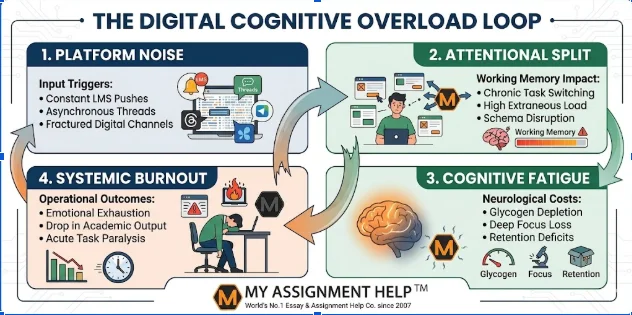
Key Strategic Takeaways
- The Digitization Overload: Multi-platform educational ecosystems are inducing acute cognitive friction and sensory exhaustion among Canadian post-secondary students.
- Psychological Implications: Academic pressure combined with constant connectivity significantly degrades deep focus and working memory retention capacities.
- Strategic Academic Delegation: Ethical academic assistance models are evolving as structured counter-measures to psychological burnout under extreme engineering and science workloads.
- Institutional Redesign Imperatives: Higher education frameworks in Canada must move away from fractured micro-assessments toward holistic, human-centric instructional architectures.
The contemporary Canadian higher education landscape is defined by an absolute integration of digital architecture. From the lecture halls of the University of Toronto to the laboratory hubs of the University of British Columbia, the traditional analog student experience has been systematically replaced by an omnipotent network of Learning Management Systems (LMS), asynchronous discussion threads, automated grading algorithms, and persistent push notifications. While this rapid technological evolution was initially championed as a democratic leap forward for institutional accessibility and administrative efficiency, it has introduced a complex, unquantified toll on the human mind: the systemic accumulation of cognitive friction. The modern campus is hyper-connected, yet the very individuals navigating it are facing an unprecedented operational deficit characterized by psychological exhaustion and cognitive fragmentation.
As post-secondary institutions across Ontario, British Columbia, and Alberta increasingly lean into hybrid and fully virtual learning architectures, the boundary separating cognitive recovery from scholastic delivery has completely eroded. The human brain is inherently restricted by structural boundaries in working memory capacity and attentional processing. When forced to constantly toggle between disjointed digital interfaces, interpret vague automated evaluation systems, and maintain perpetual online visibility, students experience rapid cognitive depletion. This phenomenon, increasingly classified by educational psychologists as digital academic fatigue, directly undermines text comprehension, structural reasoning, and emotional regulation, leaving a vast demographic of Canadian scholars vulnerable to systemic academic burnout.
Navigating this complex intersection of technology and human performance requires an objective analysis of how digital delivery platforms alter memory architectures and information retention workflows. When academic pressure peaks alongside technological fatigue, seeking external guidance becomes a practical coping mechanism. Utilizing specialized educational platforms allows individuals to delegate technical tasks, ensuring they can preserve foundational mental well-being and maintain sustainable lifestyle patterns. For deep conceptual issues within behavioral sciences and human factors engineering, establishing clear guardrails around personal performance helps build long-term academic cushioning. This has driven a measurable rise in students utilizing targeted digital resources, such as specialized psychology assignment help in Canada, to offload heavy cognitive tasks during peak burnout cycles.
Quantifying Cognitive Load Theory in Modern EdTech
To fundamentally comprehend the severity of tech burnout within Canadian higher education, we must evaluate the crisis through the lens of Cognitive Load Theory, originally pioneered by John Sweller. Cognitive load is structurally split into three distinct dimensions: intrinsic load (the baseline complexity of the actual academic material), germane load (the beneficial cognitive work dedicated to processing information and constructing schemas), and extraneous load (the mental energy wasted on how the information is delivered). In an analog learning environment, instructional design focuses on maximizing germane load while respecting the finite limits of working memory. However, the introduction of unoptimized educational technology frameworks has exponentially magnified extraneous cognitive load, effectively starving the brain of the energy required for meaningful schema acquisition.
Consider the formulaic operational capacity of working memory storage during information processing. The baseline cognitive capacity equation can be modeled as:
C_{\text{available}} = C_{\text{total}} – (L_{\text{intrinsic}} + L_{\text{extraneous}})
Where C_{\text{total}} represents the total finite cognitive capacity of an individual, L_{\text{intrinsic}} represents the internal complexity of the curriculum, and L_{\text{extraneous}} represents the administrative and platform-based digital noise. As L_{\text{extraneous}} escalates due to poor interface mechanics, redundant software requirements, and fractured notification models, the remaining available capacity (C_{\text{available}}) for deep comprehension shrinks toward zero. This mathematical reality manifests as a pervasive inability among students to retain core theoretical concepts, directly driving up failure rates in complex STEM and humanities courses alike across Canadian institutions.
This operational deficit is severely worsened by the architecture of contemporary learning software. Rather than acting as transparent channels for information transfer, multiple platforms demand substantial interactive attention. A Canadian engineering student, for example, must simultaneously monitor an institutional LMS for syllabus adjustments, a separate third-party repository for code validation, digital chat forums for peer-to-peer assignments, and personal digital accounts for vital administrative updates. Each platform transition requires an abrupt shift in cognitive framing, a process that triggers structural attentional switching costs. Research in cognitive science demonstrates that these rapid micro-transitions systematically deplete the brain’s glycogen reserves, accelerating the onset of mental exhaustion and lowering overall analytical problem-solving thresholds. If the technology itself feels overwhelming, our beginner’s tech help guide breaks down common tools in plain language.
The Phenomenon of Tech Burnout Among Canadian Post-Secondary Students
Tech burnout within higher education is not merely a state of temporary fatigue; it is a clinical syndrome resulting from chronic, unmanaged digital stress. According to nationwide data compiled by the Canadian Mental Health Association (CMHA) and post-secondary health surveys, over 70% of Canadian university students report feeling overwhelmed by their academic workloads, with a major sub-section identifying digital fatigue as a primary driver of psychological distress. Unlike traditional academic stress, which typically spikes during midterms and final examination periods, digital burnout is linear and continuous, sustained by the relentless pace of 24/7 online classrooms and immediate response expectations.
In Canada’s unique socioeconomic landscape, this crisis is exacerbated by the reality of the “student-worker” identity. A substantial portion of the student population at institutions like Toronto Metropolitan University, McGill University, or the Southern Alberta Institute of Technology (SAIT) must balance demanding academic tracks with part-time professional employment to manage rising urban living costs. When a student transitions directly from an eight-hour remote workstation shift to a grueling four-hour block of asynchronous online lectures and digital quizzes, their visual and neurological systems receive absolutely no downtime. The absence of clean boundaries between professional obligation, academic performance, and personal life creates a chronic loop of psychological stress, resulting in severe clinical manifestations including insomnia, emotional detachment, and acute task paralysis.
When this threshold of exhaustion is reached, the capability to perform independent critical research diminishes, making basic deadlines feel completely unmanageable. To prevent total academic failure and protect their mental well-being, many students are forced to re-evaluate their operational workflows and selectively outsource time-consuming projects. For those managing complex core programs alongside demanding schedules, choosing to securely Pay Someone to Do My Homework serves as an effective risk-mitigation strategy. By leveraging structured academic support channels, students can step away from continuous screen engagement, allowing their neurological processing systems to recover from the chronic effects of over-digitization while keeping their grade point averages stable.
Data Analysis: The Statistical Reality of Post-Secondary Exhaustion
An objective, empirical look at Canadian institutional data reveals a clear correlation between the intensity of digital tool integration and the decline of student mental health metrics. Over the past several academic cycles, multi-institutional surveys tracking student experiences across major provincial jurisdictions have highlighted a sharp rise in psychological stress indicators coinciding with the permanent adoption of hybrid delivery models. The table below represents an aggregated trend profile derived from institutional satisfaction metrics, counseling center reports, and student wellness evaluations across representative Canadian university systems between 2022 and 2026.
Key Metrics of Student Digital Fatigue (2022–2026)
| Academic Year | Average Screen Time (Academic, Daily) | Reported Digital Burnout Rate (%) | Counseling Center Intake Volume Increase | Measured Schema Retention Index (1–10) |
| 2022–2023 | 5.8 Hours | 52% | Baseline | 6.8 |
| 2023–2024 | 6.5 Hours | 59% | +14% | 6.1 |
| 2024–2025 | 7.2 Hours | 66% | +23% | 5.4 |
| 2025–2026 | 7.9 Hours | 73% | +31% | 4.9 |
The statistical data illustrates an inverse relationship between daily academic screen time and the calculated Schema Retention Index—a metric indicating a student’s ability to recall core conceptual principles six months post-course completion. This correlation points directly to a major challenge within modern educational design: as institutions deploy more software interfaces to manage learning, student retention drops significantly. The data highlights that the persistent use of digital platforms impairs long-term memory formation, turning learning into a short-term process of clicking through interface requirements rather than deeply mastering the content.
The Neurological and Psychological Toll of Screen Dependency
Beyond educational frameworks, the neurological impact of chronic digital exposure presents a severe threat to long-term cognitive development. Neurobiological research indicates that extended periods of screen reliance and high-frequency digital task-switching cause measurable changes in prefrontal cortex activity. This region of the brain regulates executive functions, including selective focus, prospective planning, impulse control, and logical reasoning. When the prefrontal cortex is continuously bombarded by notifications and forced to process highly fragmented information, it enters a state of chronic overstimulation. This leads to a down-regulation of dopamine receptors, requiring increasingly intense stimuli to maintain focus, which severely impacts a student’s ability to engage with dense text or follow long, complex lecture arguments.
Psychologically, the consequences are equally disruptive. The constant pressure to remain connected creates a state of perpetual hyper-vigilance, where the brain treats a missed deadline or unread notification as an immediate threat. This state of persistent stress keeps cortisol levels elevated, directly damaging hippocampal structures vital for turning short-term memories into stable long-term knowledge. Over time, students frequently experience an ongoing sense of low self-efficacy. When the simple act of opening a browser triggers a wave of stress due to past digital exhaustion, learning stops being an engaging intellectual pursuit and becomes an overwhelming psychological chore, often resulting in widespread avoidance behaviors and academic withdrawal.
Strategic Mitigation Frameworks for Students and Faculty
Resolving the cognitive crisis in Canadian higher education requires a collaborative, two-sided approach that pairs systemic institutional reforms with personalized productivity strategies for students. Faculty members must recognize that technology should serve as an intake catalyst rather than an administrative hurdle. This requires a deliberate shift away from fragmented grading models that mandate continuous weekly online discussion posts, video submissions, and minor micro-quizzes across distinct platforms. Instead, instructional designers should adopt streamlined digital structures that favor high-quality, singular assignment pathways, giving students clear, uninterrupted time to focus on deep, intensive study without continuous interface distractions.
On an individual level, Canadian students must implement rigorous digital boundaries to protect their cognitive health. This includes adopting structured habits like the Pomodoro technique alongside physical adjustments, such as using hardware-level website blockers during deep focus sessions and creating strict offline windows after standard hours. Furthermore, academic communities must work to remove the stigma around seeking structural support when workloads become unmanageable. Utilizing verified academic networks and professional writing platforms shouldn’t be viewed as a personal failure, but rather as a practical workflow adjustment to protect mental health. Delegating routine data collection or initial content drafting can help students restore structural balance, ensuring they retain the energy needed to master their core areas of study. Simple aids help too: a free word counter for assignments keeps essay lengths on track without extra mental effort.
Conclusion: Reclaiming the Human Element in Canadian Education
The digitization of Canadian higher education is an irreversible trend, yet its current trajectory demands significant re-evaluation. Educational tools should serve to expand human intellectual capability, not exhaust the fundamental neurological systems that support learning. As the metrics around student burnout and cognitive fatigue continue to climb, maintaining a hands-off approach to technology integration is no longer viable. Ensuring the long-term success of Canada’s future professional and technical workforce requires an immediate commitment to human-centered design principles within our higher education systems.
Reclaiming an effective balance demands that university administrators, faculty members, and technology developers look beyond simple engagement metrics and actively design for long-term cognitive health. By reducing unnecessary digital overhead, prioritizing clean user experiences, and encouraging healthier work-study boundaries, we can transform digital environments from sources of chronic stress back into powerful tools for intellectual exploration. Until these systematic changes are broadly adopted, students must remain active protectors of their own mental well-being, utilizing every available resource and support framework to navigate the intense demands of the modern digital campus. For practical software tips, follow our latest tech updates.
Frequently Asked Questions (FAQ)
Q1: What exactly defines “cognitive cost” within a digital learning framework?
Cognitive cost refers to the finite mental energy and working memory capacity consumed by navigating complex, unoptimized digital interfaces, tracking multiple communication channels, and managing software requirements. When this administrative overhead is high, it starves the brain of the energy needed to process, synthesize, and store actual academic concepts.
Q2: How does tech burnout differ from standard academic stress?
Standard academic stress is usually cyclical, peaking during midterms or finals and subsiding after deadlines pass. Tech burnout is a chronic, continuous condition driven by 24/7 connectivity, constant push notifications, and the breakdown of clear boundaries between academic work and personal recovery time, leading to persistent mental exhaustion.
Q3: Why are Canadian university students particularly vulnerable to digital fatigue?
Many Canadian students balance demanding academic programs with part-time jobs to manage high costs of living in major urban centers. Transitioning directly from professional screen work to complex online learning environments leaves their neurological systems with no recovery time, accelerating cognitive exhaustion.
Q4: What immediate steps can instructors take to reduce extraneous cognitive load?
Instructors can consolidate their digital workflows by using a single platform for all communications, assignments, and grades. They can also replace multiple low-stakes weekly digital tasks with focused, high-value assignments, giving students clear blocks of uninterrupted time for deep study.
About the Author
Dr. Aris Thorne
Senior Educational Psychologist & Academic Strategy Director
Dr. Aris Thorne holds a PhD in Cognitive Science with a focus on human-computer interaction in educational spaces. With over eleven years of instructional design experience across North American universities, Dr. Thorne currently leads research into student performance workflows and digital workload balancing strategies, helping students achieve sustainable academic success.
Empirical Sources & References
- Sweller, J. (2011). Cognitive Load Theory: Historical Background and Current Themes. Educational Psychology Review, 23(1), 29-38.
- Canadian Mental Health Association [CMHA] (2024). Post-Secondary Student Wellness Trends and Digital Fatigue Reports. Canadian Campus Wellbeing Survey Archive.
- Government of Canada, Statistics Canada (2025). Economic Realities and Work-Study Patterns Among Post-Secondary Demographics. Ottawa: Queen’s Printer.
- National College Health Assessment [NCHA] (2025). Canadian Reference Group Executive Summary on Student Mental Health Outcomes. Association of American College Health Outcomes.